Buying guide
How to Choose a Leaf VacuumThat Fits Your Yard and Cleanup
Match the machine to your leaf volume, moisture, debris, surface and disposal workflow before you compare the numbers on the box.
Most leaf-vacuum buying advice starts with CFM, MPH and mulch ratio. That is convenient for manufacturers because numbers fit nicely on boxes.
It is also backwards.
The reason is simple.
A leaf vacuum can have impressive suction and still be a miserable machine to own if you spend half the job emptying its bag, clearing clogs, untangling a cord, changing batteries or digging an acorn out of the impeller.
The underlying owner research repeatedly points to the same buying problem: the real question is whether the machine's collection method, debris tolerance and operating conditions match the actual property.
The short version
That first row is not automatically better than the second, and the last row does not mean you need the highest mulch ratio available. Context remains stubbornly immune to marketing.
Do you actually need a leaf vacuum?
Before choosing a leaf vacuum, ask whether collecting leaves by suction solves a problem you actually have.
A leaf blower moves material quickly but does not collect it. A leaf vacuum collects leaves and usually shreds them. A mower or mower-bagger can be more efficient across open turf. A lawn sweeper can make sense for large, relatively open areas. A rake remains annoyingly effective, requires no charging and has yet to receive a firmware update.
For light to moderate leaf coverage on turf, mowing may eliminate the collection problem entirely. University of Minnesota Extension recommends mulch-mowing dry leaves and notes that the technique can save the labor of collecting them; once leaf accumulation becomes excessive, bagging or removing material becomes more appropriate.
Buy a leaf vacuum when collection is the problem. Do not buy one merely because leaves exist.
A vacuum makes the strongest case when you need to remove leaves from places where leaving them is undesirable, you want the material collected or shredded, or raking and bagging create too much manual work. If your real job is simply "move these leaves off the lawn," a blower or mower may be the cleaner answer.
Choose by leaf volume, not yard size
"Small yard" and "large yard" are crude descriptions. A small garden under several mature deciduous trees can produce a ridiculous amount of material. A much larger property with few trees may produce very little.
Ask instead: How many leaves do I deal with during the worst cleanup of the season?
Think in terms of actual material: a thin scattering, several small piles, repeated large piles, bags and bags of leaves, or a continuous carpet of leaves under mature trees.
This matters because the collection system eventually becomes the limiting factor. A handheld vacuum may pick leaves up perfectly well and still be the wrong tool if its bag fills every few minutes.
Current walk-behind machines illustrate just how different the scale can become. Billy Goat's KV601, for example, uses a 69 cm working width and a 151 L collection bag, while the self-propelled version weighs about 60 kg before you add collected debris.
If leaf volume is high enough that collection capacity will dominate the job, stop shopping among handheld vacuums no matter how impressive their motor specifications look.
Dry leaves are easy. Your actual yard is the test.
A clean pile of crisp dry leaves is basically the leaf-vacuum equivalent of a laboratory mouse: convenient, cooperative and not remotely representative of everything outside your house.
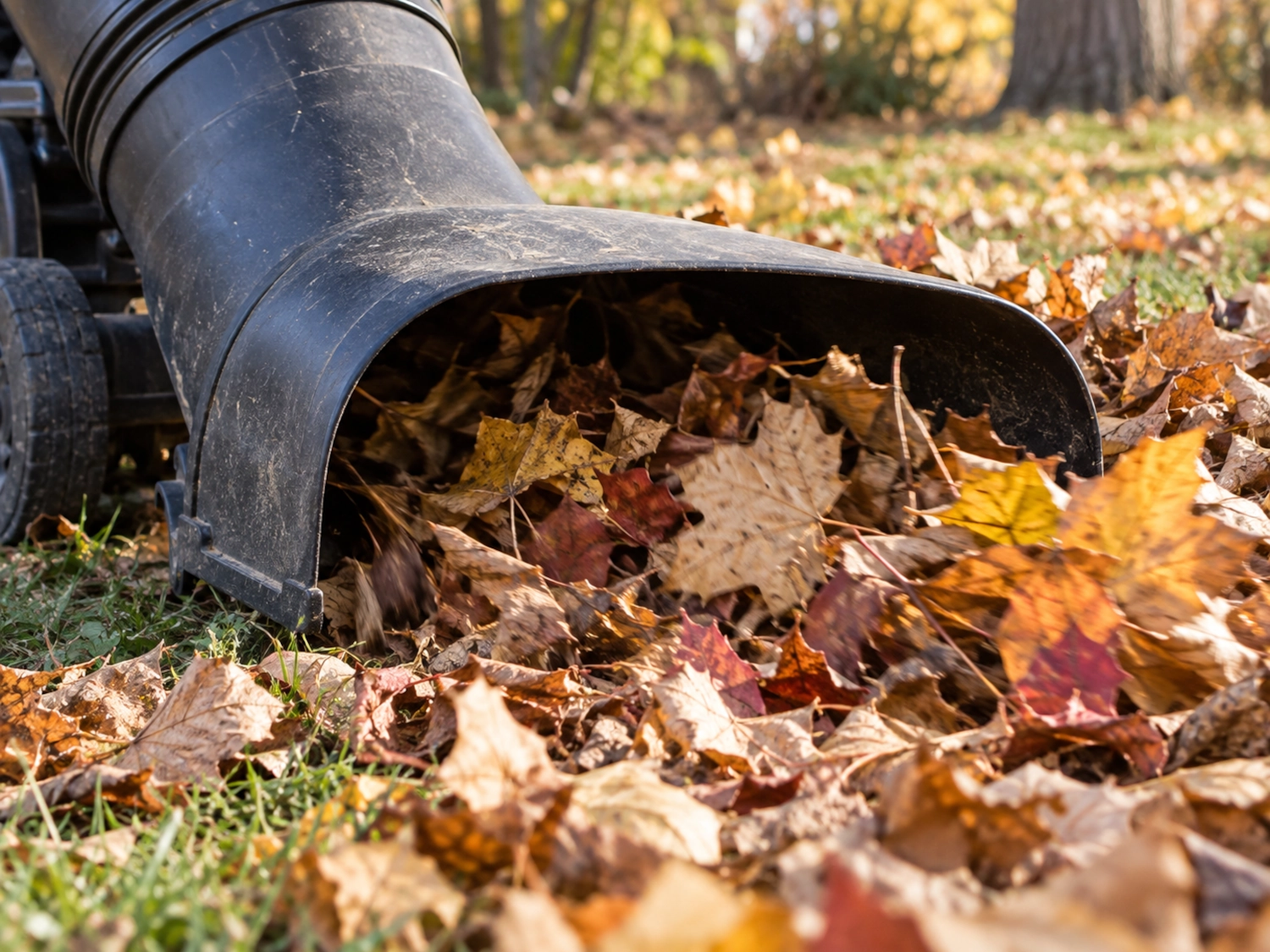
Look at what normally gets mixed into your leaves. Dry leaves are the easiest material for most machines. Damp or wet leaves are heavier and more prone to matting and clogging. Twigs and sticks can obstruct an intake or damage vulnerable components. Acorns and nuts are hard debris heading straight toward the impeller. Pine cones can be bulky for small intakes. Pine needles behave differently from broad leaves. Mulch and bark are easy to collect accidentally. Gravel and stones bring both machine-damage and surface-disturbance risk.
This is not theoretical. Toro's current UltraPlus manual instructs users to vacuum only dry leaves and soft material and specifically warns that sticks, rocks, acorns and pine cones can damage the impeller. The same manual warns that force-feeding debris can clog or damage the machine.
But "leaf vacuums cannot handle wet leaves" is too simplistic. Independent hands-on testing by Bob Vila found substantial differences among machines: some units handled wet, matted leaves, twigs and acorns well, while even a large walk-behind vacuum sometimes needed another pass on wet material and could partly block on longer sticks.
The useful question is not "Does a leaf vacuum work on wet leaves?" It is "What happens to this particular design when damp leaves arrive in quantity?"
If wet leaves are normal rather than exceptional where you live, treat wet-material performance and clog access as buying requirements, not bonus features.
Be very careful with gravel and decorative stone
A vacuum cannot elegantly distinguish between "leaf I want" and "small hard object directly underneath leaf." That becomes important on gravel drives, decorative stone, mulched beds and similar surfaces.
Some larger machines are intentionally designed for multiple surfaces. Billy Goat, for example, specifies adjustable intake height for turf and hard surfaces and even offers wear protection for harsher conditions. That does not mean every leaf vacuum belongs on gravel.
Toro's handheld vacuum instructions specifically warn against hard objects including rocks because of possible impeller damage.
If much of your cleanup happens over loose stone, do not assume stronger suction is better. You may want adjustable intake height, very good suction control or no vacuum at all.
Blowing leaves away from the stone before collection is often the less stupid approach.
Handheld vs walk-behind vs tow-behind
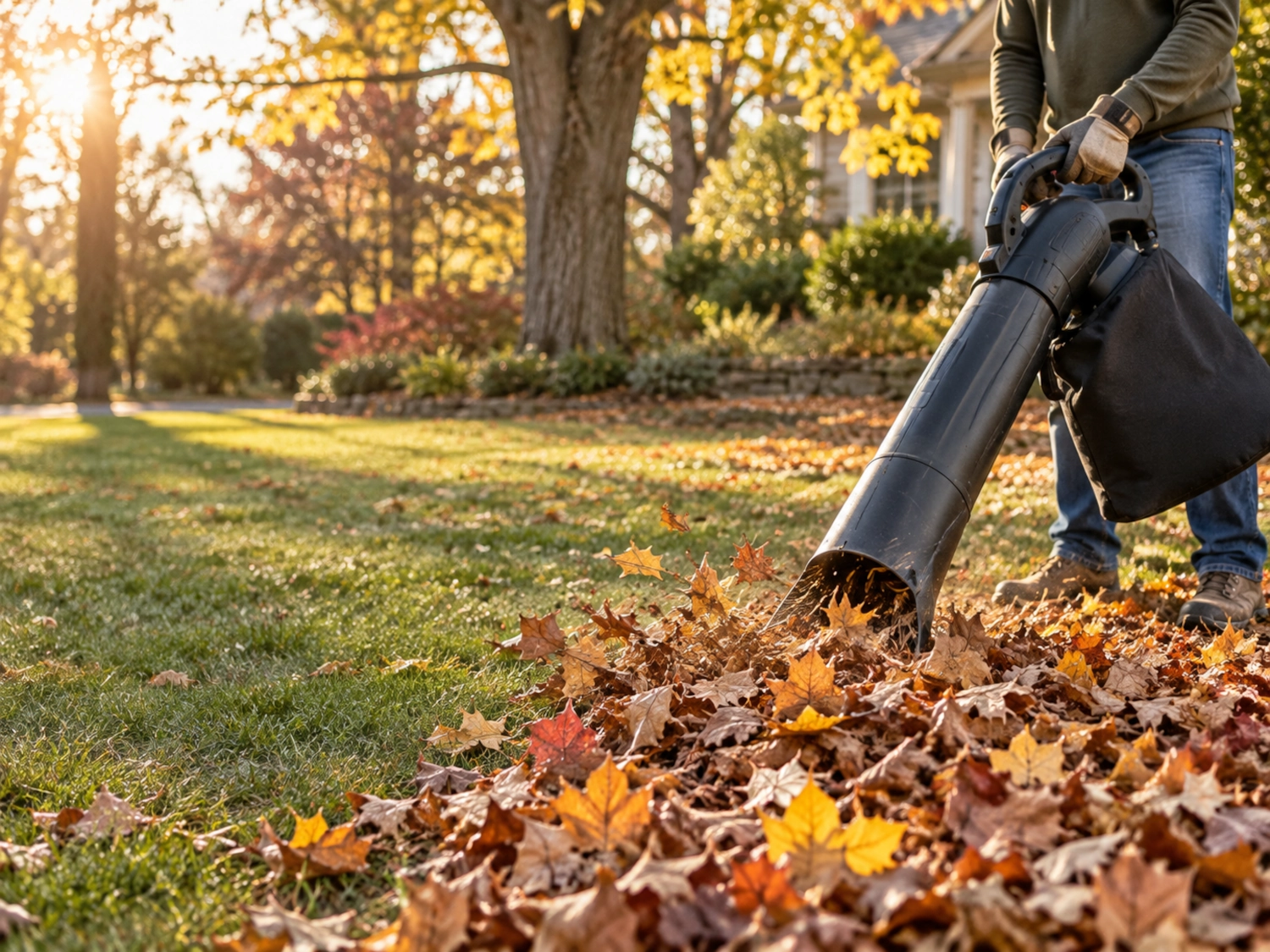
Handheld and blower-vac combinations
Best when the material volume is modest and access matters more than raw throughput.
Good fitshrubs, garden beds, patios, fences, porches, narrow passages and landscaping where larger machines cannot fit.
Many combine blowing, vacuuming and mulching. That can be genuinely useful because real leaf cleanup often involves blowing leaves out of awkward places before collecting them.
Capacity is limited, and the bag does not remain magically weightless after you fill it.
Best fitsmaller cleanup jobs, tight areas and users who value maneuverability.
Poor fithuge seasonal leaf loads where a shoulder bag becomes an endlessly recurring appointment.
Walk-behind leaf vacuums
Built for lots of material spread across ground you can physically drive or push over.
Advantageswider intake, much larger collection capacity, less shoulder load and greater debris throughput.
Costsgreater weight, storage footprint, purchase cost and poorer access around tight landscaping.
Tow-behind and mower-mounted systems
Make sense when handheld bags and repeated walking no longer scale to the property.
What they solvevolume.
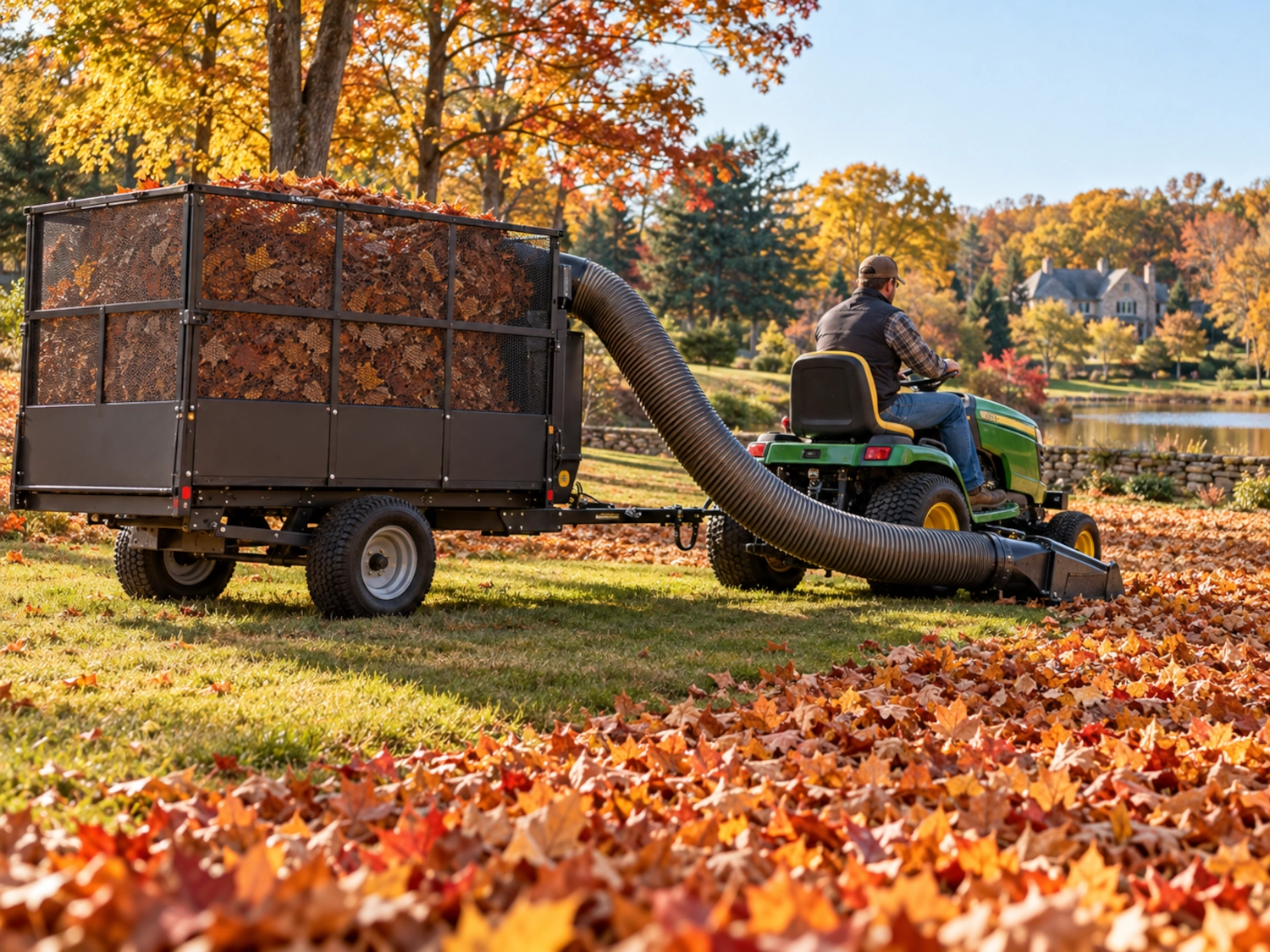
What they addbulk, storage, turning geometry, hose management, towing equipment and dumping work.
Current handheld designs illustrate the trade-off. WORX's WG509, for example, lists a 1.2-bushel collection bag, a 9.3 lb machine weight, a metal impeller and one-lever blower/vacuum conversion. Those are useful specifications, but they also tell you what to inspect: how much you must carry, how much the bag holds, and how annoying switching modes will be.
Self-propelled drive becomes relevant on heavier walk-behind machines because the machine itself can be heavy. Billy Goat's current KV601SP is about 60 kg and uses rear-wheel drive; the manufacturer specifically positions the drive system as useful on slopes and longer routes.
If you are comparing heavy walk-behind models, "self-propelled" is not a luxury badge. It is an ergonomic decision.
Tow-behind collection is a different scale of solution. This class is about volume; the trade-offs are bulk, storage, turning geometry, hose management, towing equipment and dumping the collected material afterward.
Do not buy acreage-scale machinery because your lawn is technically large. Buy it because your leaf load is large enough to justify acreage-scale machinery.
Corded vs cordless vs gas
There is no universally superior power source. There are only different ways of being inconvenienced.
Corded electric
The major advantage is obvious: you do not stop because a battery is empty. It can be sensible for smaller properties with accessible outlets. The disadvantages are range and cord management. Trees, fences, furniture and landscaping turn a theoretically adequate extension cord into a practical obstacle course.
Cord specifications matter too. Toro's manual shows why: the manufacturer requires progressively heavier extension-cord gauges as cord length increases and limits the recommended maximum extension length for that specific model.
Do not generalize those exact figures to every machine. Follow the manual for the model you are considering.
Cordless
Cordless removes the cable and introduces the battery. That trade is attractive when the property is not huge, the expected runtime covers a normal cleanup, you already own compatible batteries, and spare batteries are reasonably priced.
Current products make clear why battery capacity belongs in the buying decision. Greenworks and Ryobi currently publish roughly 30-minute-or-more runtime claims for specific 40V vacuum configurations. Those are model-and-battery claims, not a category rule.
Voltage is not a personality trait. Also price the battery, charger and likely spare before declaring a cordless model inexpensive.
Gas
Gas remains relevant where runtime, high workload and rapid refueling matter more than noise, maintenance and engine weight.
For occasional light residential cleanup, owning another small engine can be a remarkably elaborate way to avoid using an extension cord. For heavy work, dismissing gas merely because battery tools exist is equally silly.
Do not ask whether 40V is "enough." Ask whether the exact battery configuration you intend to buy can finish your normal vacuuming session at the settings you will actually use.
CFM and MPH: useful numbers, terrible starting points
CFM means cubic feet per minute and describes air volume. MPH describes air velocity. Both can be useful. Neither tells you the whole story of vacuum performance.
Combination blower-vacuums are routinely marketed using prominent CFM and MPH figures. Current examples range from WORX's 350 CFM/210 MPH WG509 to Greenworks' 505 CFM/230 MPH 40V blower/vac.
The problem is not that those numbers are fake. The problem is assuming they answer questions they do not answer. A leaf vacuum also depends on intake geometry, tube diameter, impeller design, resistance through the collection system, debris condition, how full the bag already is, and clogging behavior.
On combination tools, verify whether headline airflow figures apply to blower operation, vacuum operation or both rather than assuming they are directly comparable.
The underlying research found insufficient evidence for any honest universal rule such as "you need at least X CFM." Model-specific numbers exist, but a defensible category-wide threshold does not.
Use CFM to compare machines only after you have matched machine class, debris type and workload. A larger irrelevant number remains irrelevant.
Mulch ratio matters less than the brochure suggests
Manufacturers commonly advertise reduction ratios such as 12:1, 16:1 or 18:1. Current examples include 12:1 from Greenworks, 16:1 from Ryobi and 18:1 from WORX.
A higher reduction ratio can be useful because shredded leaves occupy less space and may be easier to compost or reuse. But ask why you need shredding.
If your disposal system benefits from finely shredded material, mulch performance matters. If your real problem is that the machine clogs every ten minutes, an heroic mulch ratio printed on the box has not rescued you.
Likewise, if you simply want to move whole leaves to another part of the property, you may be paying for a feature that solves somebody else's problem.
Treat mulch ratio as part of the disposal workflow, not as a horsepower rating for sophistication.
Check the bag before you obsess over the motor
The collection bag is one of the least glamorous components and one of the most important.
Capacity. How long can you realistically work before stopping?
Filled weight. Can you still carry, detach or dump it comfortably?
Attachment. Does it come off cleanly or require a wrestling match?
Opening size. Will compacted shredded leaves actually fall out?
Closure. Zipper, clips or another mechanism?
Wear parts. Can you buy another bag after this one eventually loses the argument with reality?
Bag design varies materially. Billy Goat emphasizes a hard-bottom zipperless bag with quick-release fasteners on its walk-behind KV line, while Toro's manual warns that vacuum bags wear over time and should be inspected and replaced when deteriorated.
A big bag reduces emptying frequency but increases the amount of material you eventually have to handle. That is the trade-off.
"Biggest bag wins" is toddler-level product analysis.
Count interruptions, not just suction
The owner research exposes a better way to think about performance:
Effective cleanup throughput = how much material you collect minus the time and effort lost to interruptions.
Those interruptions include emptying the bag, clearing the intake, removing material from the impeller, reconnecting a hose, moving an extension cord, swapping a battery, converting between blower and vacuum, and hauling material to the disposal point.
This is not an official engineering metric. It is our editorial framework for evaluating the whole job rather than one component of it. And it explains why a vacuum can be "powerful" and still feel slow.
If Machine A collects leaves 20 percent faster but stops twice as often, the specification sheet has won and you have lost.
Impeller material matters, but "metal" is not magic
Leaf vacuums normally use an impeller both to create airflow and, on mulching models, shred incoming material. Hard debris therefore matters.
Some current products advertise metal impellers specifically as a durability and mulching feature. WORX uses a two-stage metal impeller in the WG509, while Ryobi specifies a metal impeller in its 40V vacuum/mulcher. Larger walk-behind designs may use heavy serrated impellers.
But do not reduce durability to one checkbox. Ask what debris the manufacturer explicitly allows, what debris the manual prohibits, whether you can reach the impeller safely when something jams, whether the impeller is replaceable, whether replacement bags, tubes and hoses are available, and what happens when the machine accidentally eats an acorn, twig or stone.
Toro provides a useful reality check: despite being a legitimate leaf vacuum, its manual explicitly says hard items including sticks, rocks, acorns and pine cones can damage the impeller.
The machine is not defective. It simply has an operating envelope. Your job is to determine whether your yard lives inside it.
Clog access is a specification, even when nobody prints it in large type
Sooner or later, something will obstruct the flow path. So inspect how the machine comes apart.
You want safe, obvious access to common blockage points without dismantling the device like a bomb technician.
Toro's manual includes a specific procedure for removing clogged debris from the impeller after disconnecting power and waiting for moving parts to stop. WORX highlights a quick-release mechanism intended to simplify debris cleaning.
That is the kind of feature that looks boring in a showroom and becomes fascinating fifteen minutes into a damp October cleanup.
If your property produces wet leaves, fibrous plant material or twigs, prioritize clog access heavily.
Weight on the box is not the weight you work with
Published weight usually describes the machine, and sometimes excludes the battery. That is useful but incomplete.
You may also be carrying the battery, the collection bag, several gallons or bushels of shredded leaves, and moisture contained in those leaves.
Greenworks, for example, lists its 40V blower/vac at 9.92 lb without the battery. WORX lists its corded WG509 at 9.3 lb. Those numbers are useful for comparing the bare machines, but they are not the shoulder load after the bag has filled.
For handheld machines, evaluate the whole carrying system. For walk-behind machines, evaluate pushing effort, wheel size, balance as the bag fills, slopes, turning and self-propelled drive.
Do not buy a leaf vacuum to save your back and discover that you have merely invented a more technologically impressive way to annoy it.
Think about where the leaves go after the vacuum
Vacuuming is not the end of the process. Your leaves still need to go somewhere.
Possibilities include municipal or curbside collection, compost, garden beds, a trailer, another part of the property, or reusable leaf mulch.
This affects how much mulching you need, how large the container should be and how often you are willing to empty it.
If you want to reuse the material, shredding can be valuable. Extension guidance supports shredding leaves for lawn and garden use, and notes that shredded leaves decompose more readily than whole material.
If you need whole material transported elsewhere, extreme shredding performance may matter much less than quick emptying.
Work backwards from the disposal point. It is amazing how many buying problems disappear once you know what you are actually trying to accomplish.
What to check before buying a leaf vacuum
| Step | Question | What the answer changes |
|---|---|---|
| 1 | Do I need to collect the leaves? | Vacuum vs blower/mower/sweeper |
| 2 | How many leaves arrive at peak season? | Machine class |
| 3 | Are they normally dry, damp or wet? | Intake and clog requirements |
| 4 | What else is mixed in? | Impeller and debris tolerance |
| 5 | What surfaces am I cleaning? | Vacuum suitability and height control |
| 6 | Where are the leaves physically located? | Handheld, hose or walk-behind access |
| 7 | How often am I willing to empty the collector? | Bag/container capacity |
| 8 | How heavy can the collector become before it is unpleasant? | Useful capacity, not nominal capacity |
| 9 | What happens when it clogs? | Service access |
| 10 | Corded, battery or gas? | Range, runtime and maintenance |
| 11 | Do I need the leaves finely shredded? | Importance of mulch ratio |
| 12 | Where will I dump the material? | Collection and disposal design |
| 13 | Where will the machine live for the rest of the year? | Storage footprint |
| 14 | Can I buy bags, hoses, batteries and wear parts? | Long-term ownership |
| 15 | Only now: which specs distinguish the remaining machines? | CFM, speed, capacity, runtime and other model details |
That order is deliberate.
A vacuum with 500 CFM is not "better" than one with 350 CFM if the first machine is too large for your beds, cannot handle your debris or has a bag you hate emptying.
The buying mistakes we would avoid
Our recommendation
For most buyers, the smartest leaf vacuum is not the most powerful one. It is the smallest class of machine that can handle your peak leaf volume without forcing constant interruptions.
Choose a handheld or blower-vac when access and modest volumes matter most.
Move toward a walk-behind vacuum when material volume is high enough that collection capacity and ground coverage are the bottlenecks.
Consider tow-behind or mower-mounted collection only when the property and seasonal leaf load genuinely justify equipment of that scale.
If your leaves are routinely wet, your yard contains significant hard debris, or most of the cleanup occurs over loose gravel, be much more skeptical. Those conditions can change the required machine substantially or make vacuuming the wrong method entirely.
The central buying question is not "How powerful is it?" It is "Will this machine get me through my actual cleanup with fewer stops and less physical work?"
That is what you are buying. Everything else is packaging.
Frequently asked questions
Are leaf vacuums worth it?
A leaf vacuum is worth considering when you need leaves collected rather than merely moved and when the machine's capacity matches your leaf volume. It is less compelling when a mower can mulch the leaves in place or when a blower can move them directly to the desired destination. The vacuum should eliminate work, not invent a new sequence of emptying, unclogging and carrying.
Is a leaf blower or leaf vacuum better?
Neither is universally better. A blower is primarily for moving debris. A vacuum is for collecting it and often shredding it. If your main objective is to move leaves off an open area, start with a blower or mower. If you need material collected for disposal or reuse, a vacuum becomes more useful.
Do leaf vacuums work on wet leaves?
Some do much better than others. Do not treat wet-leaf ability as a category-wide feature. Toro's UltraPlus manual, for example, instructs users to vacuum only dry leaves and soft items. Independent testing has found other machines capable of collecting wet, matted leaves, although wet material can still require additional passes or increase blockage risk.
Can a leaf vacuum pick up acorns?
Some machines can, while others explicitly warn against it. Toro lists acorns among hard objects that can damage the impeller in its UltraPlus vacuum. By contrast, independent tests of some heavier-duty machines report successful pickup of acorns. Check the specific manufacturer's instructions rather than assuming "leaf vacuum" means "yard debris vacuum."
Can a leaf vacuum pick up twigs?
Small twigs may pass through some machines, but sticks are also a common source of blockage or damage. Independent testing has found machines that process small twigs successfully while longer sticks can partially obstruct an intake. Manufacturer restrictions differ substantially.
Can I use a leaf vacuum on gravel?
Sometimes, but use caution. Some larger multi-surface vacuums provide adjustable intake height specifically for different surfaces. Other machines warn that rocks can damage the impeller. If the vacuum cannot avoid ingesting loose stone, blowing leaves away from the gravel before collection is usually the safer approach.
How much CFM does a leaf vacuum need?
There is no defensible universal CFM threshold for every leaf vacuum. Required performance depends on debris condition, intake geometry, machine class and workload. The underlying research for this guide found model-specific performance information but not enough evidence to support a universal rule such as "X CFM is enough." Use airflow as a comparison specification after determining the type of vacuum you need.
Is a higher MPH better?
Not automatically. MPH describes air velocity and is particularly prominent on blower-vac combinations. Vacuum effectiveness also depends on air volume, intake design, impeller design and the resistance created by the collection system. A bigger MPH number does not compensate for the wrong machine class or a collection system that keeps stopping the job.
What mulch ratio should I look for?
Choose mulch ratio according to what you intend to do with the collected leaves. Current machines advertise ratios ranging from around 12:1 to 18:1 in the examples checked for this guide. Higher reduction can mean fewer bags and finer material, but clogging, emptying and actual shredding performance under your debris conditions matter more than the ratio alone.
Is a metal impeller better?
A metal impeller can be a useful durability feature, particularly when the machine also shreds material, and several current manufacturers emphasize metal or heavy-duty serrated impellers. But material alone does not tell you what debris the machine safely accepts. Check the manufacturer's prohibited-debris list, clog access and replacement-part availability too.
Is a cordless leaf vacuum powerful enough?
Cordless machines can be suitable for residential leaf collection, but runtime is the more useful first question. Current manufacturer examples advertise roughly 30 minutes or more from particular 40V battery configurations, but those claims belong to those exact products and batteries. Compare expected cleanup duration with the battery configuration you will actually own.
Do I need a self-propelled walk-behind leaf vacuum?
Not always, but it becomes more valuable as machine weight, slopes and working distance increase. Billy Goat's current self-propelled KV model weighs about 60 kg and uses rear-wheel drive intended to reduce effort on slopes and longer routes. On a small, flat property, that extra mechanism may be unnecessary. On hilly ground with heavy collection, it can materially affect usability.
How large should the collection bag be?
Large enough to avoid ridiculous stop frequency, but not so large that you cannot comfortably empty it. There is no useful universal capacity because shredded-leaf density, moisture, machine type and disposal method vary. Evaluate useful capacity by asking how long you can work between stops and how manageable the collector is when full.
Will I still need a blower if I buy a leaf vacuum?
Possibly. Large vacuums cannot necessarily reach behind shrubs, around furniture, against fences or deep into planted beds. Even some walk-behind systems offer optional remote hoses specifically to reach these areas. A blower-vac combination or separate blower may therefore remain part of the workflow.
What is the single most important thing to check before buying?
Check whether the machine matches your worst normal cleanup, not an ideal demonstration. Count your leaf volume, note whether it is usually wet or dry, identify hard debris and loose surfaces, and estimate how often the collector will fill. If the vacuum survives that reality test, then compare specifications.
Research method
How we researched this guide
This is a research-based buying guide, not a claim that we physically tested every type of leaf vacuum.
The starting research examined homeowner discussions and specialist forums to identify recurring post-purchase problems, including wet-leaf clogging, frequent emptying, full-bag weight, mixed debris, hose frustration and machines that were simply too small for the leaf load.
Community evidence was used to identify questions and failure modes, not to establish universal technical facts. The research itself explicitly warns that forum evidence is not statistically representative of all buyers.
Technical and operating claims were then checked against current manufacturer product documentation and manuals. Independent hands-on testing was used where useful to show how performance varies under wet leaves and mixed debris.
Our recommendations are editorial judgments based on that evidence. We deliberately do not recommend specific models here because choosing the model is a separate decision after you have established the required machine class, debris tolerance, collection capacity and power source.
Sources
- Toro - UltraPlus Blower/Vacuum operator documentationDry-leaf use, hard-debris warnings, clog clearing, bag wear and cord requirements.
- WORX - WG509 TRIVAC official specificationsBag capacity, weight, airflow, air speed, mulch ratio, metal impeller and mode switching.
- Greenworks - 40V 505 CFM blower/vacuum specificationsAirflow, air speed, weight, mulch ratio, battery configuration and advertised runtime.
- Ryobi - 40V Leaf Vacuum/Mulcher specificationsRuntime, metal impeller, mulch ratio and battery ecosystem.
- Billy Goat - KV601 official product documentationWalk-behind capacity, width, intake-height adjustment, bag design, impeller and hose options.
- Billy Goat - KV601SP official product documentationSelf-propelled drive and machine weight context.
- Bob Vila - leaf vacuum hands-on testingIndependent context on wet leaves, twigs, acorns and walk-behind performance.
- Pro Tool Reviews - leaf vacuum buying guide and reviewsIndependent context on machine classes, clogging, wet material and scale of use.
- University of Minnesota Extension - fall leaf mulching guidanceMower mulching as an alternative to collection where leaf accumulation is suitable.
- University of Illinois Extension - leaf reuse guidanceLeaf shredding and reuse context.